Today, the world feels a little quieter and less bright. Dr. Jane Goodall, the primatologist who rewrote science, the conservationist who spent a lifetime giving voice to the voiceless, the UN Messenger of Peace who carried hope into schoolrooms and summits, has passed away. For millions she was an icon. For me she was a mentor, a guide, and the single conversation that reshaped my life.
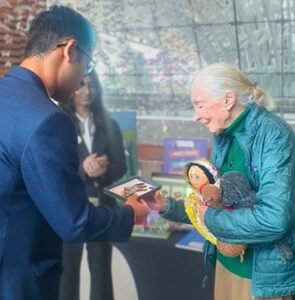
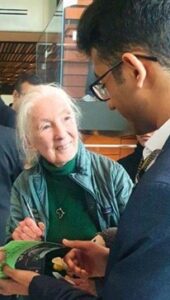
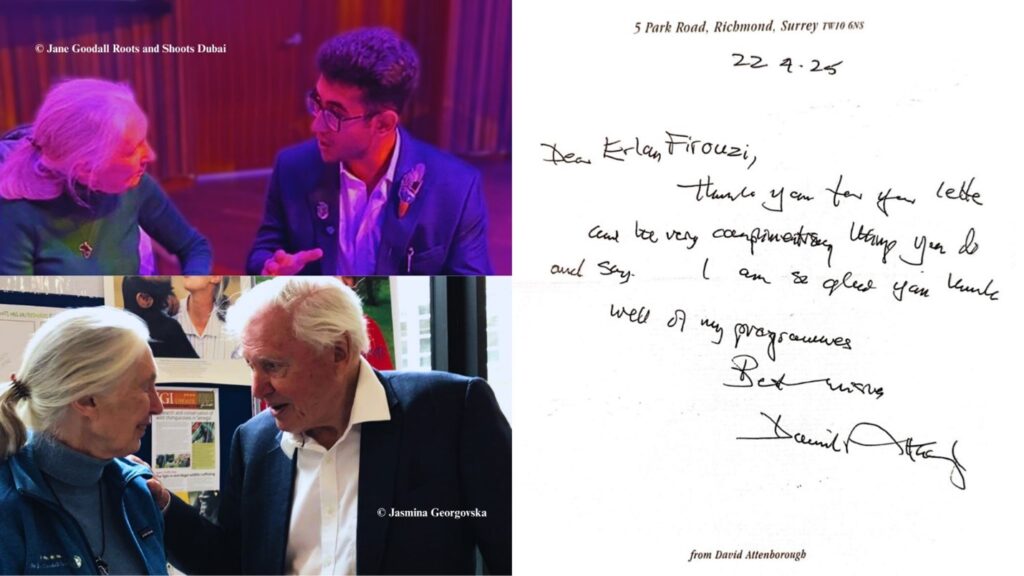
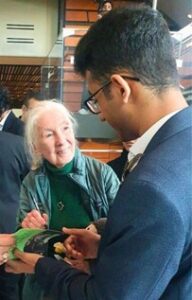
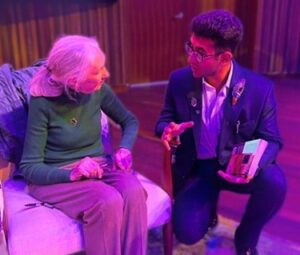
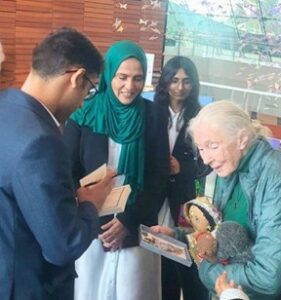
In February, just before I left to study at Monash University in Australia, I met her in person at the Roots & Shoots UAE Awards at Expo Terra, Dubai. That meeting, brief, intimate, and impossibly charged, remains the compass I come back to when I feel exhausted, defeated, loosing hope, or afraid for the future of the natural world. When I had the honour of meeting her, I wasn’t just standing before a pioneering scientist, but before a soul who radiated kindness, wisdom, and a love for life that could move mountains. I still remember the way she listened, truly listened, as if every word I said mattered. Her gentle smile, her calm presence, and her unwavering belief in the goodness of humanity touched me in a way I will never forget.
How it began: a child with worms in her bed
My own path to conservation began as a messy, awkward love affair with life itself. I was the child who brought insects to my bedroom similar to how Dr Jane brought wriggling earthworms into bed, both of us more curious than afraid. I peered at crabs in creeks, though nervous of their pinch. I overturned desert shrubs at night with a torch, finding foxes, beetles, and hedgehogs. I devoured Darwin’s writing, lost myself in documentaries, collected specimens, and eventually poured that work into my book, The Year Earth Changed.
Curiosity always came first. Jane often told the story of her own childhood curiosity, she told us that at four, she crawled into a henhouse to wait, four long hours, just to learn where eggs came from. Other parents might have scolded. Hers encouraged her. That patience and curiosity created a scientist. When I first heard her story, I recognized myself in it and I remember thinking, yes: this is the same hunger I felt. That hunger led me to speak at COP28, COY18, TEDx, and to work with Roots & Shoots groups across India and the UAE.
The room at Expo Terra (and the way she entered)
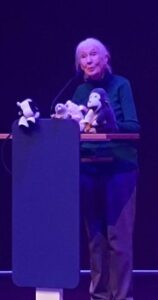
The Expo Terra Pavilion thrummed with energy the day Jane arrived. There were students from twelve schools out of more than two hundred who had been part of Roots & Shoots UAE, all of them there to show the heart of a movement Jane started: that young people, given a chance, will protect what they love.
Jane entered quietly. No dramatics, no grand fanfare, just a steady presence that filled the room. She moved with a calm dignity that made the hall hush, not because she demanded it but because attention was willingly given. Reham Zia introduced me. My chest felt full and small at the same time; I had rehearsed lines that evaporated when she looked at me with those eyes that had watched chimpanzees at Gombe and seen the world change in ways few of us can imagine.
As I Shaked, I shared my journey that her team previously mentioned to her, I told her about the 300 specimens, about The Year Earth Changed, about speaking at international forums, about my contributions to Roots & Shoots India and how despite being invited to see her, I’d missed seeing her there. I told her, quietly, one of the truths I rarely say out loud: that sometimes the scale of extinctions and climate breakdown makes me wonder whether my work matters and I question holding on to hope.
She listened. Not politely, not distractedly, she listened with her whole being, I could see the connection in her eyes and in her beautiful smile, the way she once patiently observed chimpanzees until they revealed the truth of themselves.
Then she spoke.
“You, young man, are taking Jane Goodall’s Roots & Shoots around the world.”
Those words landed like a gift and a task all at once. I felt them root inside me. Later, she added to me. and to the room, words that have become my armor on hard days:
“With people like you advocating for biodiversity, the future looks bright.”
They were not just words. They were a gift, a charge, and a responsibility. Since then, whenever I lost hope and courage her voice popped in my head, reignited that flame on me. She showed me that hope is not naive, but a powerful force that fuels action.
A feather, a chimpanzee, and the most humbling moment
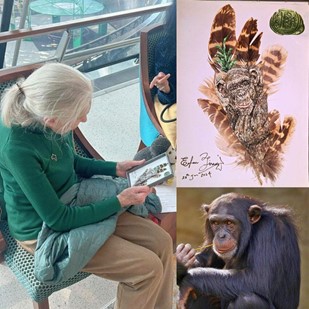
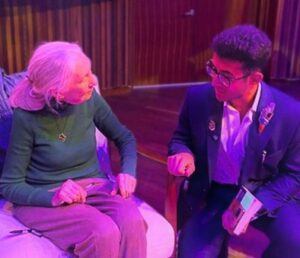
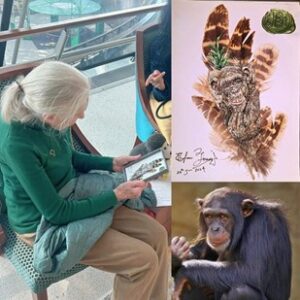
I wanted to give her something that spoke beyond words, something that carried the weight of everything she had taught me without a single sentence spoken. So I brought a gift, small and delicate: a chimpanzee painted on a pheasant feather.
It was not grand, not expensive, not the kind of object one gives to a woman who had received medals, awards, and honors from presidents, prime ministers, and kings. It was something quiet. Something fragile. Something made by my own hands.
The choice of a feather was deliberate. A feather is light, easily broken, almost weightless in the palm. And yet, it carries flight, it carries journeys, it carries life itself. To me, it symbolized the ecosystems we fight to protect, so delicate they can shatter in an instant, yet so resilient they can endure if we care for them. And on it I painted the face of a chimpanzee, David Greybeard, because Dr Jane Goodall often said her favorite chimpanzee is a very special chimpanzee named David Greybeard! David was the very first individual to trust Jane when she began her observations in Gombe, Tanzania in 1960. From her, I had learned how to watch, how to wait, how to notice the personality in another being, how to see wonder in the smallest detail of life.
When I placed the feather in her hands, she held it the way one might hold something living. She turned it gently, studying the brushstrokes, as if the painted chimpanzee might breathe. And then she smiled, a soft, radiant smile that felt like sunlight breaking through cloud.
She told those around her that she wanted to take it home, and that was very special cause she usually does not do so. In that moment, my breath caught. Here was a woman who had spent a lifetime on the road, who had received thousands upon thousands of gifts from children, admirers, and world leaders alike. And yet, of all of them, my feather painting stood out to her. The thought that something I made with my own hands had touched her heart, that it resonated with the very creatures who had shaped her soul, was the most humbling moment of my life.
I will never forget her face as she held it. There was reverence there, not for the feather itself, but for what it represented. A chimpanzee, fragile and enduring. A life, fragile and enduring. Hope, fragile and enduring.
She also signed my copy of The Book of Hope. That inscription has become a sacred anchor. On nights when the world feels unbearably heavy, when I hear of forests burning, oceans choking, or another species slipping silently into extinction, I turn to her words. They steady me.
Because hope, as she taught me, is not naive. It is not the absence of despair. It is the choice to rise in spite of despair. It is an act of courage. It is discipline. It is love made practical.
The conversation: hope, war, childhood curiosity, and science that changed
Our talk moved from personal to vast, intimate to global. She told stories that illuminated how she thought about hope and resilience. She reminded me that she had lived through World War II as a child and that she saw how human spirit and leadership could revive hope even when the world seemed lost. That memory, she said, underlies much of her faith: if people can rise from such despair, people can also repair a broken planet. She recalled how professors scoffed at her when she gave names to chimpanzees instead of numbers, told her it was “not scientific” to attribute emotion and personality to animals. She pushed back, through observation and patience, and proved them wrong. Jane broke open the idea that humans were uniquely possessing of minds and emotions. She showed the world that chimpanzees use tools, feel, mourn, and demonstrate individuality.
She told stories of animals across the planet, not just chimpanzees, but apprentices of compassion. She spoke of giant African forest rats trained to detect landmines and sniff out ivory, of Pig (named pigcasso) the painting pig whose art sold for thousands, and of cows and the cruelty of factory farming. She told us about mangroves returning, and about how nature, given a chance and help, can bounce back.
She talked about the indomitable human spirit: the man who went blind at 21 and became a magician, the people who refuse to give up. She called this the “indomitable spirit” and insisted it was part of why she kept hope alive. Even at 91 she was still traveling the world. 300 days a year because hope requires presence and stubborn persistence.
And she returned to her refrain, the instruction she passed down to millions of young people:
“Together we can. Together we will. Together we must save the world.”
Roots & Shoots in practice: India, UAE, and the invitation to Australia
My work had already taken me to places where Jane’s influence is not abstract but operational. In October 2024 I led a workshop at the Jane Goodall Institute India titled “Biodiversity Under Threat.” The institute wrote to say my talk resonated, that it sparked conversations and actions among the young people there. Working with Roots & Shoots UAE I witnessed projects that were small in scale but enormous in heart: mangrove planting, bee gardens, educational outreach in underserved communities.
When I told Jane about these projects, she smiled and, just before I departed for Monash University, extended an invitation that felt like a benediction: she personally invited me to join Roots & Shoots Australia, taking from me my business card and expanding my role internationally. That invitation was not fame; it was trust. It was a passing of responsibility, a torch lit and placed in my hands.
What her passing means, and what it compels
Jane’s death is a profound loss for science and conservation. She was a scientist who insisted that compassion belongs in the lab and the forest. She was an advocate who showed that data and humanity are not enemies. She was, most importantly to me, proof that a single life of curiosity and persistence can alter the arc of how an entire field thinks.
But her death is also a summons. She taught that hope is active and must be practiced: planting mangroves after they are cut, rescuing bee colonies, training local people to protect habitat, mentoring children, supporting those who face social injustice, and demanding that those in power think beyond quarterly profit and toward the seventh generation.
Her words to me are not just consolation. They are a charge. I will carry that charge into my studies at Monash, into my podcasts, into every lecture hall and classroom I enter, and into the conservation projects I help run. I will carry her words in my heart and mind, her signature in my book, and her stories in my head when nights get long.
A final promise
“ Dr. Jane Goodall’s roots run deep. Her shoots now reach farther than she could ever have traveled in a single lifetime, into classrooms in Dubai, into field stations in India, into mangrove nurseries tended by volunteers, into the bee gardens of children, and into the hearts of young people everywhere who will rise to carry her name forward.
To the woman who taught us to listen, to watch, to wonder, and to respond: thank you. The conversation we shared will never fade into memory. It will remain my compass, my anchor, my call to action.
But I know this much: Dr. Jane would not want us to be consumed by sorrow. She would not want our grief to end in silence. What she would want is for us to carry her torch with strength and courage, to transform our mourning into movement. She would want us to plant a tree for her, to protect a forest for her, to rescue a bee colony for her. She would want us to defend the rights of every living being, and to nurture the fragile harmony between people and nature.
Because hope, as she reminded us, is not something we wait for, it is something we create, every time we choose to care for the Earth. Every act of compassion, every seed planted, every voice raised for the voiceless is a thread of hope woven into the future.
So goodbye, Jane. The world may be quieter without you, but because of you, it is braver, stronger, and more determined than ever. Your torch burns in our hands now, and we will not let it go dark.
Where there is biodiversity, there is hope. And I will keep that hope alive, not just in words, but in action, as you asked us to do.”
— Erfan Firouzi
Author of The Year Earth Changed
Roots & Shoots Advocate
Bachelor of Science Student, Monash University